

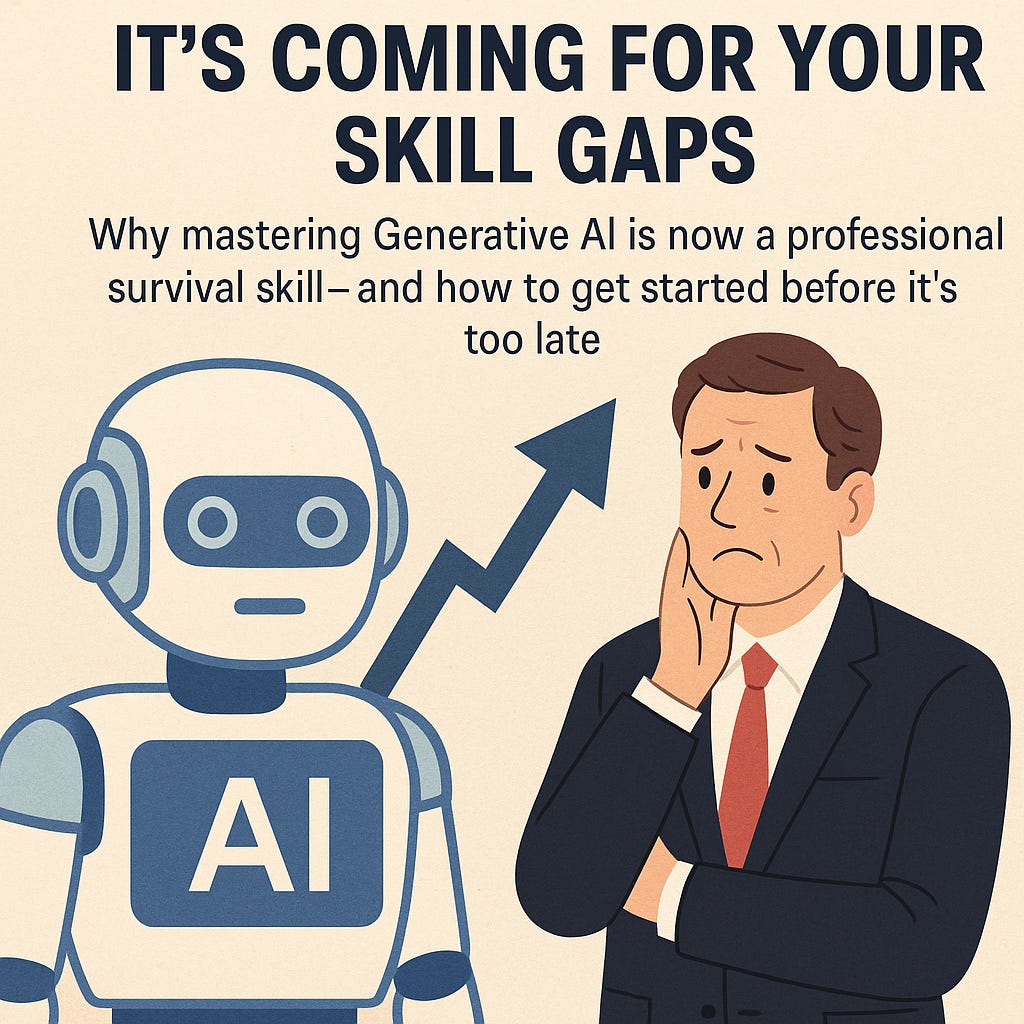
AI Isn’t Coming for Your Job—It’s Coming for Your Skill Gaps
Why mastering Generative AI is now a professional survival skill—and how to get started before it’s too late.

Over the past few days, weeks, months—actually years—it seems like you can't escape AI headlines. Everywhere you look, there's another article warning that AI is coming for your job. And let’s be honest, the hype isn’t all smoke and mirrors. The capabilities of AI are evolving at breakneck speed, and yes, some of that news is legitimately unsettling. But here’s the kicker: if AI is going to change your job, doesn’t it make sense to understand how it works first?
Companies are actively experimenting with Generative AI to optimize workflows and reduce costs. And while some are succeeding, others are pulling a corporate version of the "oops, my bad" by rehiring employees after realizing AI alone didn’t deliver as expected. Still, tasks like customer service, scheduling, data crunching, financial analysis, and even code reviews are increasingly being handed off to the machines. So the question becomes: what about new hires? Are companies still hiring, or is AI filling the ranks?
Turns out, yes, companies are still hiring—but with a catch. They’re starting to expect new employees to arrive already equipped with AI skills. Makes sense: if organizations are betting big on AI, they want people who can hit the ground running and help them extract real value from their tech investments.
That doesn’t mean humans are out of the loop. Quite the opposite. Smart companies recognize that human oversight is still critical. AI is a tool, not a replacement. But if you're not comfortable using it? You're likely to be viewed as a liability rather than an asset.
Here’s the critical takeaway:
AI isn’t a passing trend. It’s a core part of the future of work. If you ignore it, you risk falling behind—and your company risks being buried under inefficiencies that competitors will happily eliminate with the help of AI.
Addressing Real Concerns About AI in the Workplace
Is the fear of "AI taking your job" overblown? Not entirely. It’s true that some roles will be displaced, but in the short term, the real danger lies in not knowing how to use it. If you choose to sit this revolution out, you risk being less productive than your peers. And if you're in a leadership role, your office may quickly lose its edge.
That said, there are valid concerns:
AI should be used responsibly, with guardrails in place.
Employees need training to ensure safe, ethical, and productive usage.
Companies must plan for what happens when automation significantly reduces the need for certain roles.
CIOs and CAIOs must ensure that AI tools are secure and don’t pose risks like data leakage or bias.
Ignoring these issues doesn’t make them go away—it just makes it more likely that you’ll be outpaced by someone who took the time to understand the landscape.
It's Not Just Entry-Level Jobs
If you think this only impacts junior staff, think again. Entry-level roles may be the first to go, but mid-level and senior positions aren’t far behind. In fact, leaders who don’t understand how to leverage AI may find themselves replaced by those who do. Efficiency is king, and generative AI is its new court advisor.
In a recent survey I ran at an organization, we aimed to establish a baseline for operational improvements post-AI rollout. Ironically, the two departments least responsive to the survey were the ones most ripe for AI optimization: Finance and Research & Analysis. The absence of engagement in that survey said everything—if you're not paying attention, you may be the one most at risk.
What to Do If You Feel Threatened by Generative AI
First, take a breath. Then, take action:
1. Learn it, experiment with it, play with it.
There are countless courses—both free and paid—that can help you build up your skills. Not only will this keep you competitive, but it will also help you see where AI can improve your workflow and your life.
2. Be proactive in your organization.
Meet with your CIO or CAIO to discuss how AI could improve your work environment. Review your business processes. Suggest a pilot AI tool. Become the AI evangelist in your department.
3. Join a community.
Whether it’s online forums like Reddit or LinkedIn groups, or a work-based Microsoft Teams chat, find others who are using AI and exchange ideas, prompts, and success stories.
4. Stay curious and stay involved.
Don’t wait for someone to tell you how to use AI. Own the journey. Tinker, test, iterate.
In Short
AI isn’t going anywhere. It will get better, faster, and smarter. If you don’t evolve with it, you risk getting left behind. But if you lean in and learn, you could become indispensable.
Here Are Some Great Resources to Get You Started:
LinkedIn Learning ($) – Courses on generative AI, neural networks, deep learning, computer vision, and more
Anthropic AI Fluency (Free) – Learn to collaborate with AI systems
OpenAI Academy (Free) – Explore the fundamentals of the AI era
Coursera (Free) – Courses like "Generative AI with Large Language Models"
Google Cloud Skills Boost (Free)– Hands-on training in Generative AI
Let AI work for you. Just make sure you’re part of the equation.
Thanks for sharing! If anything, I would argue that those who stand to benefit the most from AI are senior folks, because they’re best placed to assess the quality of what AI produces. Senior leaders who aren’t using or can’t use AI are definitely missing out and will be left behind in my view (meaning I agree with you!).