

AI Is Your Workforce Enabler, Not Replacer
Understanding Generative AI and Governance Is the Key to Thriving in the Modern Workforce

Generative AI came out of the gate with a bang. ChatGPT alone became the fastest-growing consumer application in history, reaching over 100 million users within its first two months. That momentum hasn’t stopped. It sparked a renaissance in AI adoption and spawned the public deployment of competitors like Claude, Grok, and a growing number of niche and enterprise-specific models. We’re watching a global AI arms race unfold as nations, companies, and innovators compete to develop the most capable, versatile, and influential models. Every day, there are articles in mainstream media heralding breakthroughs, raising alarms, or both. LinkedIn has transformed into a sea of AI consultants, thought leaders, and self-proclaimed experts. Meanwhile, some companies are taking drastic action, announcing sweeping layoffs with claims that AI will take over those responsibilities.
This isn’t the first time the workforce has been reshaped by technology. The industrial revolution, the advent of the personal computer, and the rise of the internet all triggered massive shifts. But this moment feels different—because of the pace, the scale, and the proximity of AI to human-like outputs. That said, many companies are missing the point: AI is not here to replace us. It’s here to enable us.
Why the Workforce Needs to Understand Generative AI
If you plan to stay in the workforce for the next five, ten, or twenty years, understanding generative AI is no longer optional. Knowing how to use these tools to enhance your productivity, spark innovation, and make smarter decisions is rapidly becoming as essential as knowing how to send an email or manage a spreadsheet.
Workers should view generative AI the same way we viewed the calculator or the internet: as a tool. Not a threat. To identify some online AI training sessions, see last week’s post on AI isn’t coming for Your Job – It’s Coming for Your Skill Gaps.
Yes, AI can:
Generate new ideas and starting points
Summarize large volumes of data or documents
Identify patterns and anomalies
Automate basic, repetitive tasks
Act as the first line in customer interactions
Monitor complex systems and report anomalies
But it can’t:
Think for you
Understand context
Make high-stakes decisions with empathy or nuance
Be accountable
That’s why a human in the loop is always necessary. As Apple engineers recently pointed out, large language models give the illusion of thinking —but they don’t understand what they say. Anthropic researchers went further, describing a circuit trace analysis of how LLMs process a query. They respond based on probability and pattern-matching, not reasoning or insight, and may not tell you the truth as to how they found the solution.
The Role of AI Governance
As the capabilities grow, so must the guardrails.
AI governance isn’t a side task—it’s a central pillar of responsible innovation. We need transparency into how models make decisions. We need diverse training data to account for and counteract bias. And we need ethical frameworks to prevent misuse.
Pioneering AI professor De Kai has argued that we should view artificial intelligence systems as children in need of careful guidance. In his work Raising AI (2025), he proposes a civic framework modeled after Parent-Teacher Associations (PTAs) in schools—community-based groups that support and oversee the ethical development of AI systems. These AI PTAs would provide a structured forum for education, oversight, and accountability. More broadly, we should emphasize the foundational principles of Permission, Transparency, and Accountability (PTA) as necessary governance pillars before allowing AI systems to operate independently, particularly in sensitive or high-impact domains.
Governance also ensures trust. Workers will be more willing to collaborate with AI if they understand it, trust its outputs, and know there are humans involved in the final decisions.
Augment, Don’t Replace
The goal should never be to fully replace humans. It should be to augment the workforce. Give people tools to:
Work faster and smarter
Make better decisions with clearer information
Spend less time on tedious, repetitive work
Free up creative and strategic energy
This is a moment of immense potential—if we approach it correctly.
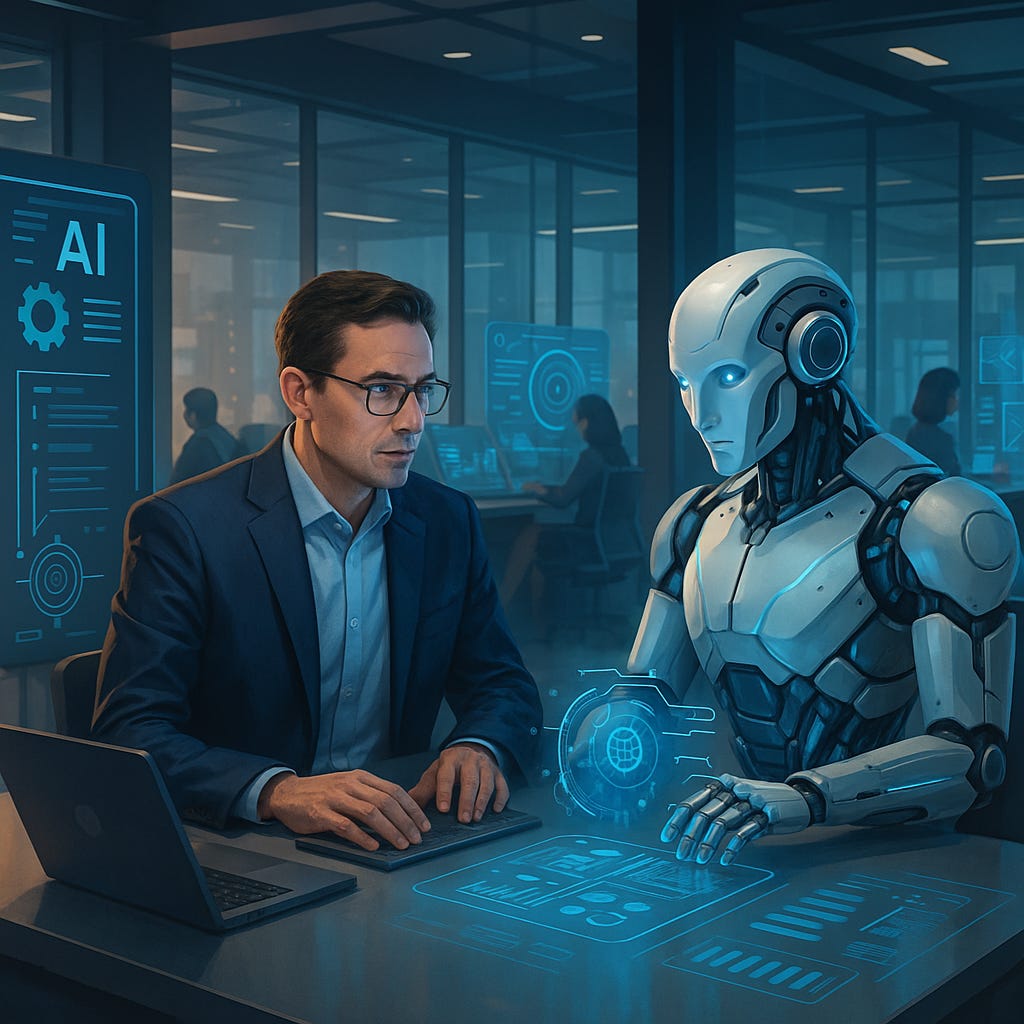
If leaders deploy AI as a shortcut to cutting headcount, they will face backlash, lower morale, and a loss of institutional knowledge. But if they use it to invest in their people, to upskill teams, and to co-pilot alongside human intelligence, the payoff will be transformational.
AI is here. It’s powerful. But it needs us.
Let’s stop asking whether AI will replace the workforce.
Let’s start asking how the workforce can use AI to evolve.